Understanding Keyboard Design Philosophy
Keyboards are no longer just simple input devices. Over time, manufacturers have started designing keyboards with specific purposes in mind. Some keyboards are designed to keep the hands and wrists in a natural position to reduce strain during long typing sessions. Others are designed to maximize speed, reduce input delay, and improve reaction time in gaming environments.
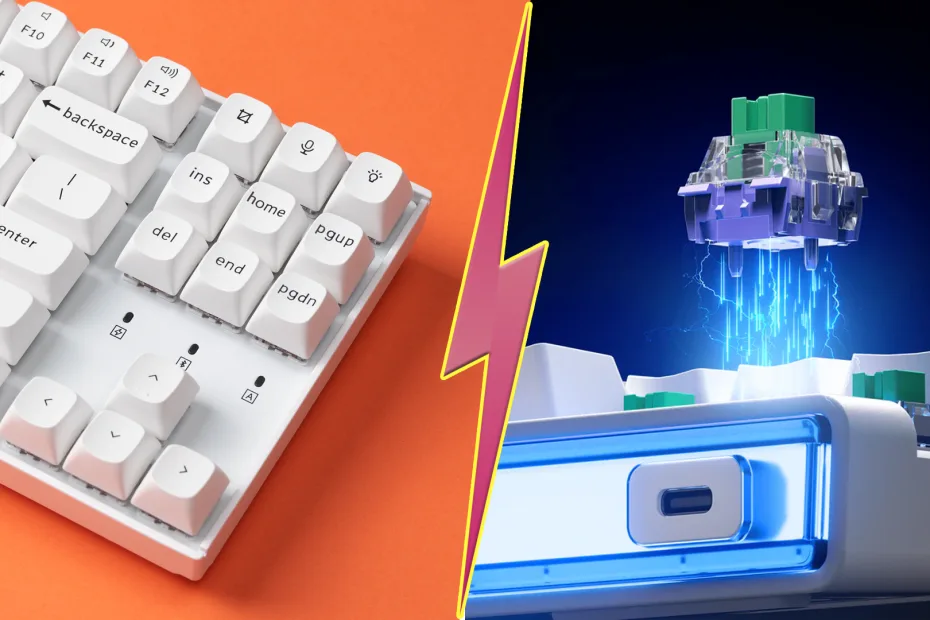
This has led to two broad categories of keyboard design. One focuses on ergonomics and comfort, while the other focuses on performance and responsiveness. Neither design is universally better than the other. The right choice depends on how a person uses their keyboard and how many hours they spend using it every day.
What Makes a Keyboard Ergonomic
Ergonomic keyboards are designed to reduce stress on the wrists, fingers, and shoulders. Traditional keyboards force the hands into a straight, inward angled position that is not entirely natural for the human body. Over long periods of typing, this position can lead to wrist strain, finger fatigue, and sometimes repetitive strain injuries.
Ergonomic keyboards attempt to solve this problem by changing the shape and layout of the keyboard. Some ergonomic keyboards split the keyboard into two halves so that each hand can rest at a more natural angle. Others introduce a slight curve in the key layout so that the fingers do not need to stretch as far to reach certain keys. Some designs also include wrist rests or tilted typing angles to improve posture.
The goal of an ergonomic keyboard is not speed but comfort and long term health. People who spend many hours typing every day, such as writers, programmers, lawyers, office professionals, and even gamers, often benefit the most from ergonomic designs.
Performance Focused Keyboard Design
Performance focused keyboards are built with a different goal in mind. Instead of prioritizing comfort, they prioritize speed, responsiveness, and efficiency, especially for gaming. These keyboards are often more compact, with layouts such as tenkeyless, 65 percent, or 60 percent. The smaller size allows more room for mouse movement, which is particularly important in competitive gaming.
Performance keyboards also tend to focus heavily on switch responsiveness, polling rate, and build stability. The goal is to reduce the time between pressing a key and the computer registering the input. Even small improvements in response time can make a difference in fast paced games.
Many performance oriented keyboards also have a higher typing angle and a more rigid case design to prevent flex during intense gaming sessions. The emphasis is on precision and consistency rather than comfort over long typing sessions.
Comfort Versus Speed
The main difference between ergonomic and performance keyboards comes down to comfort versus speed. Ergonomic keyboards are designed to reduce fatigue and prevent strain during long periods of typing. Performance keyboards are designed to make inputs as fast and accurate as possible.
Someone who types for eight hours a day may find an ergonomic keyboard much more comfortable and sustainable in the long run. On the other hand, a competitive gamer who needs quick reactions and large mouse movements may prefer a compact performance keyboard.
Interestingly, many users eventually try to find a balance between the two. Some compact keyboards now include ergonomic features such as adjustable typing angles, removable wrist rests, or programmable layouts that allow users to optimize both comfort and performance.
The Importance of Desk Setup and Posture
It is important to remember that the keyboard alone does not determine comfort or performance. Desk height, chair position, monitor level, and mouse placement all play a role in how comfortable and efficient a setup feels.
An ergonomic keyboard will not completely solve discomfort if the desk setup is poor. Similarly, a performance keyboard will not automatically improve gaming performance if the mouse sensitivity and posture are not optimized. The keyboard should be considered one part of a larger setup that includes the desk, chair, monitor, and mouse.
Finding the Right Keyboard for Your Use
Choosing between an ergonomic and a performance focused keyboard depends largely on how the keyboard is used. If a person spends most of their time typing documents, writing emails, coding, or doing office work, comfort should be a priority. In such cases, an ergonomic keyboard may be the better choice.
If the keyboard is primarily used for gaming, especially competitive gaming that requires fast reactions and large mouse movements, a performance focused compact keyboard may be more suitable.
For many users, the ideal solution lies somewhere in the middle. A tenkeyless or 65 percent keyboard with a comfortable typing angle and good wrist support can provide both performance and comfort without extreme compromises.
The Future of Keyboard Design
Keyboard design continues to evolve as manufacturers experiment with new layouts, materials, and switch technologies. Many modern keyboards now try to combine ergonomic comfort with high performance features. Adjustable typing angles, programmable layers, magnetic switches, and split compact layouts are becoming more common.
As users become more aware of posture, wrist health, and long term comfort, ergonomic features are likely to become more common even in gaming keyboards. At the same time, performance features such as faster response times and customizable actuation will continue to improve.
Ultimately, the best keyboard is not simply the most expensive or the most popular one. The best keyboard is the one that fits naturally into a user’s daily routine, feels comfortable to use for long periods, and supports the kind of work or gaming they do most often. Choosing between ergonomic and performance focused designs is therefore less about which one is better and more about which one is better for you.