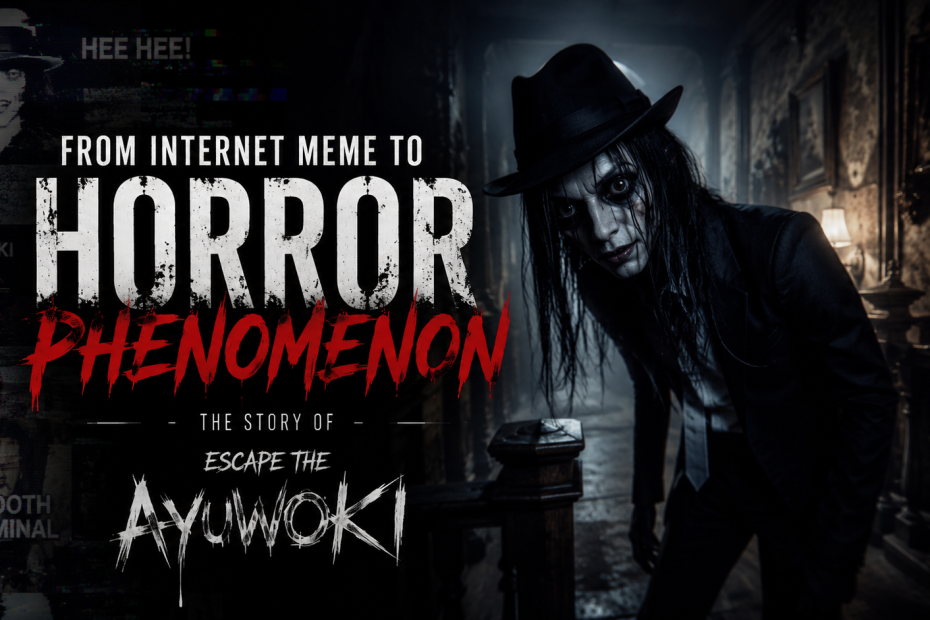
From Internet Meme to Horror Phenomenon
The story of Escape the Ayuwoki is unlike that of most horror games. Its roots can be traced back to a viral internet video featuring a strange animatronic character whose appearance and movements quickly caught the attention of online communities. The creature became known as the Ayuwoki, a name derived from a humorous misinterpretation of lyrics from Michael Jackson’s song Smooth Criminal.
What started as an internet joke soon developed into something much larger. Images, videos, and stories about the Ayuwoki spread across social media platforms, turning the character into a modern internet legend. Recognizing the potential of the concept, developers transformed the meme into a survival horror game that embraced the unsettling atmosphere surrounding the character.
The result was Escape the Ayuwoki, a game that successfully blended internet culture with classic horror design.
A Simple Premise with Constant Tension
At its core, Escape the Ayuwoki places players inside a dark and mysterious mansion where they must find a way to escape while avoiding the creature that stalks them through the halls. The objective appears straightforward, but the execution creates a constant sense of anxiety. Players are forced to explore unfamiliar environments, search for clues, and solve puzzles while remaining aware that danger can appear at any moment.
Unlike action oriented horror games that encourage confrontation, Escape the Ayuwoki focuses on vulnerability. Players are not equipped to fight back. Survival depends on staying hidden, remaining alert, and making smart decisions under pressure. This sense of helplessness becomes one of the game’s greatest strengths.
The Power of Atmosphere
One reason Escape the Ayuwoki resonated with horror fans was its effective use of atmosphere. The game understands that fear often comes from anticipation rather than direct confrontation. Dark corridors, distant sounds, flickering lights, and moments of silence all contribute to an environment that keeps players constantly on edge. Every room feels as though it might contain a new threat, even when nothing immediately dangerous is present. This careful pacing creates tension that builds gradually throughout the experience. Instead of relying entirely on sudden scares, the game encourages players to imagine what might be lurking nearby.
The result is a style of horror that remains effective long after the initial surprise has faded.
The Role of the Ayuwoki
The creature itself plays a significant role in the game’s popularity. The Ayuwoki is unsettling because it exists somewhere between familiar and unfamiliar. Players recognize elements that seem connected to a well known cultural figure, yet the final appearance feels distorted and unnatural.
This combination creates discomfort in a unique way. The character is not frightening because of extreme violence or graphic imagery. Instead, it is frightening because it feels strangely wrong. The unpredictable nature of the creature’s movements adds another layer of tension. Players never feel entirely safe, and every encounter becomes memorable because of the uncertainty surrounding what the Ayuwoki might do next.
How Internet Culture Shaped the Experience
Few horror games are as closely tied to internet culture as Escape the Ayuwoki. The game’s popularity grew largely through social media, livestreams, reaction videos, and online discussions.
Watching streamers experience the game became almost as entertaining as playing it. The suspense, surprise, and genuine reactions created countless memorable moments that spread across the internet.
This community driven exposure helped the game reach audiences far beyond traditional horror fans. Many players discovered it because they were already familiar with the meme that inspired it.
In this way, the game’s success demonstrates how internet culture can influence modern game development and create entirely new forms of storytelling.
More Than Just a Meme
It would be easy to dismiss Escape the Ayuwoki as a novelty project built around a viral joke. However, the game’s lasting popularity suggests there is more to it than that.
Beneath its unusual origins lies a well executed horror experience that understands the importance of atmosphere, pacing, and player vulnerability. The developers took a concept that could have remained a temporary internet trend and transformed it into something capable of standing on its own.
This achievement is one reason the game continues to be remembered years after its release.
The Enduring Appeal of Indie Horror
Independent horror games often succeed because they are willing to explore unconventional ideas. Without the constraints of major studios, developers can experiment with unusual concepts and create experiences that feel fresh and unpredictable. Escape the Ayuwoki is a perfect example of this creative freedom. It demonstrates how an unexpected source of inspiration can evolve into a compelling game when combined with thoughtful design and a strong understanding of horror.
Its success also highlights the power of community engagement in modern gaming. A concept born from internet humor became a recognizable horror title because players embraced and shared the experience.
Final Thoughts
Escape the Ayuwoki remains one of the most fascinating examples of how internet culture and gaming can intersect. What began as a viral meme eventually became a tense and memorable survival horror experience that captured the attention of players around the world.
By combining psychological tension, stealth based gameplay, and a uniquely unsettling antagonist, the game carved out a distinct identity within the indie horror genre. It stands as proof that inspiration can come from the most unexpected places and that even an internet joke can evolve into something genuinely memorable.
For horror fans, Escape the Ayuwoki is more than a curiosity. It is a reminder that some of the most effective scares come from taking something familiar and transforming it into something completely unexpected.